Deterministic wildfire forecasts provide a single prediction of fire behavior, but they do not convey confidence, variability, or the likelihood of extreme outcomes. In strongly coupled fire–atmosphere systems, small uncertainties can lead to large differences in fire evolution.
To address this limitation, Janice Coen and collaborators developed a framework for conducting and communicating probabilistic wildland fire forecasts using ensembles of coupled weather–fire simulations. The approach explicitly propagates uncertainty in weather, fuels, and model physics to characterize the range of plausible fire behavior.
Wildland fires are inherently nonlinear systems. Small differences in wind, fuel distribution, or fire-induced flow can substantially alter spread rate, direction, and intensity. As a result, a single deterministic simulation may appear precise while masking critical uncertainty.
Probabilistic fire modeling replaces a single forecast with a distribution of possible outcomes, enabling risk-based interpretation, identification of low-probability but high-consequence scenarios, and more transparent communication of forecast confidence and limits.
The probabilistic framework was demonstrated using ensembles of the CAWFE coupled weather–wildland fire model applied to multiple large wildfires. Ensembles incorporated uncertainty from meteorological initial and boundary conditions, fuel loading, and selected physical parameterizations.
Results showed that uncertainty introduced through model physics often exceeded that from weather or fuels alone, producing wide, skewed, or multi-modal outcome distributions. These results highlight the importance of ensemble-based interpretation and the need to better understand structural uncertainty in coupled fire–atmosphere models.
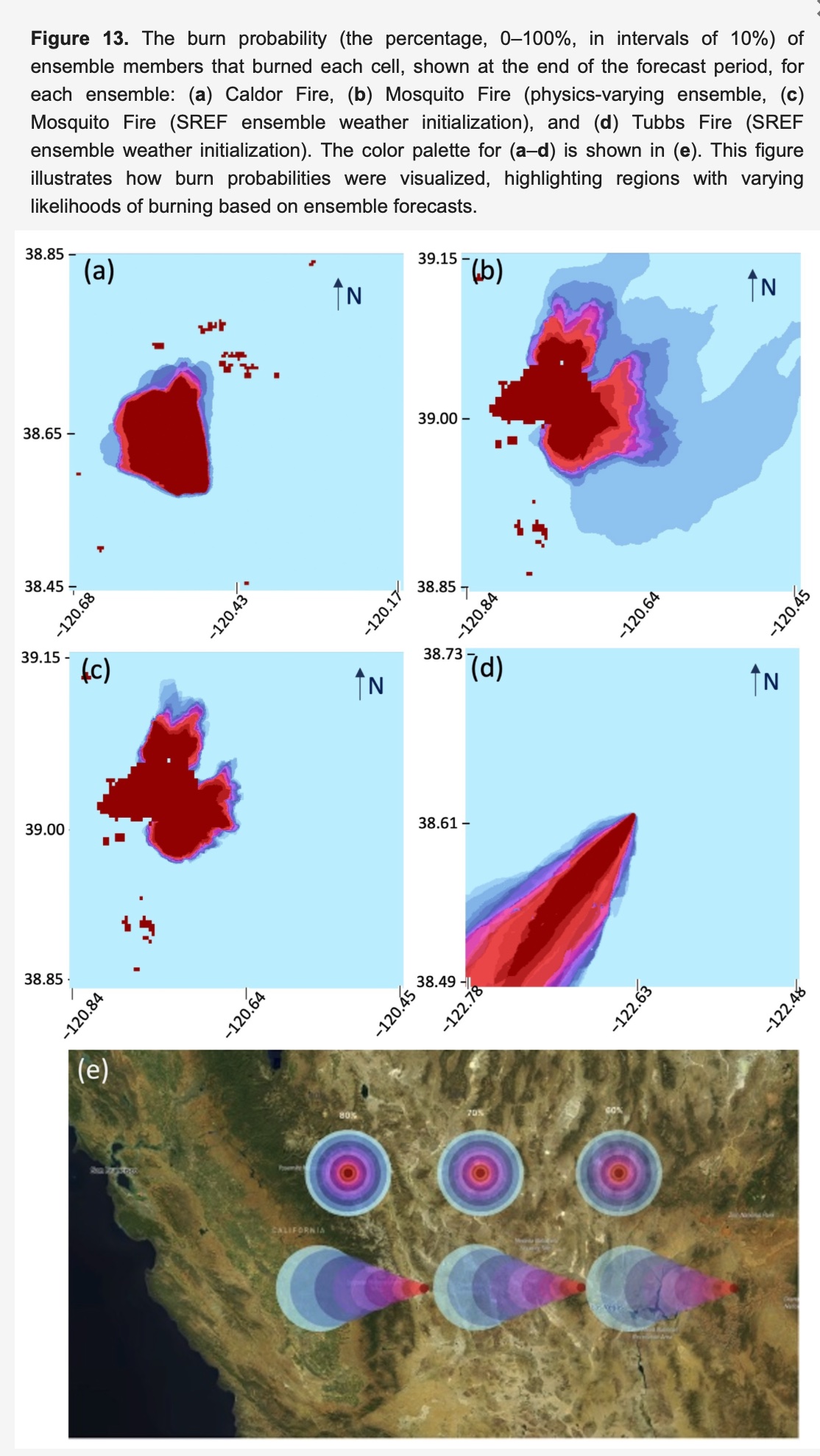
Figure 13. Examples of probability distributions produced by ensemble wildfire simulations, illustrating cases with narrow uncertainty, broad uncertainty, skewed distributions, and multi-modal outcomes. These distributions demonstrate how different sources of uncertainty can lead to fundamentally different forecast confidence and risk interpretation. From Coen et al. (2024), Fire, 7, 227. © 2024 The Authors, distributed under the Creative Commons Attribution (CC BY) license .
The framework emphasizes not only ensemble generation, but also the effective communication of uncertainty through products such as burn probability, spread rate statistics, and intensity-related metrics. Visualization strategies were designed to meet accessibility standards and support interpretation in both research and applied decision-making contexts.
--
Reference
Coen, J. L.; Johnson, G. W.; Romsos, J. S.; Saah, D., 2024: A Framework for Conducting and Communicating Probabilistic Wildland Fire Forecasts. Fire, 7, 227. https://doi.org/10.3390/fire7070227 . © 2024 by the authors. Distributed under the Creative Commons Attribution (CC BY) license.