
Microphysics
Physics Contents
WRF Physics Overview
Cumulus Parameterization
Microphysics
Radiation
Planetary Boundary Layer (PBL) Physics
Surface Physics
Using Physics Suites
Physics Options for Specific Applications
Microphysics Overview
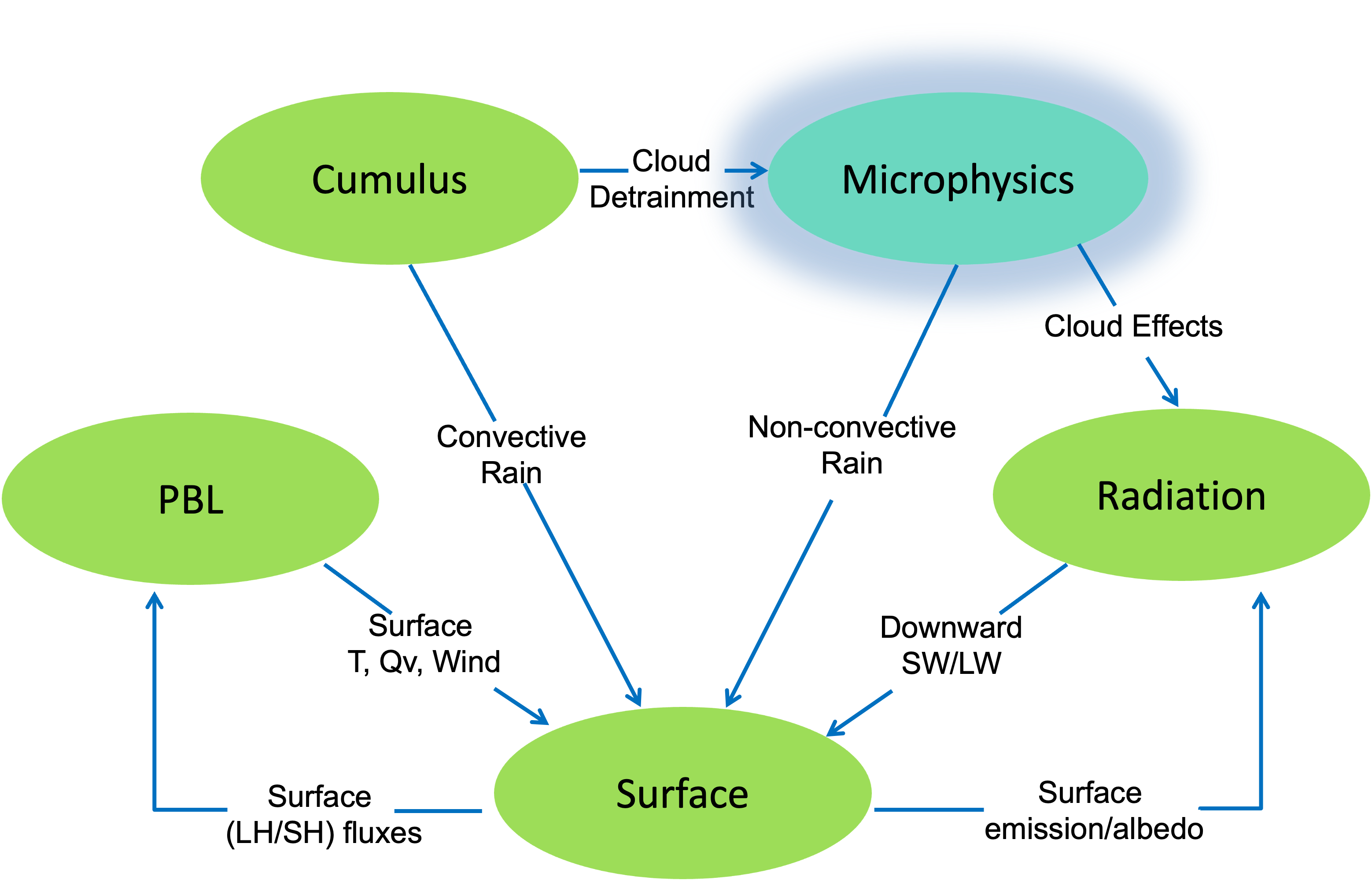

WRF microphysics schemes are responsible for resolving water vapor, cloud, and precipitation processes, and some schemes account for ice and/or mixed-phases processes. Microphysics schemes provide atmospheric heat and moisture tendencies to the radiation scheme, and the resolved-scale (or NON-convective) rainfall to the surface scheme. WRF microphysics schemes take into account many different microphysical processes, and formation of particles differs, depending on their type.
Cloud droplets (10s of microns) condense from vapor at water saturation.
Rain (~mm diameter) forms from cloud droplet growth.
Ice crystals (10s of microns) form from freezing of droplets or deposition on nuclei, which are assumed or explicit (e.g., dust particles).
Snow (100s of microns) forms from growth of ice crystals at ice supersaturation and their aggregation.
Graupel/hail (mm to cm) form and grow from mixed-phase interactions between water and ice particles.
Precipitating particles are typically assigned to an observationally-based size distribution.
There are many types of microphysics schemes available in WRF. Single-moment schemes have a single prediction equation for mass per species, with particle size distribution being derived from fixed parameters (Qr, Qs, etc.). Double-moment schemes add a prediction equation for number concentration per double-moment species (Nr, Ns, etc.), and allow for additional processes, such as size-sorting, during fall-out and aerosol effects. Spectral bin schemes resolve size distribution by doubling mass bins. The more advanced the scheme type, the more computationally expensive the model simulation will be.
Note
For additional details, see the `WRF Tutorial presentation on Microphysics`_.
Microphysics Options
In the below table, abbreviations are defined as follows
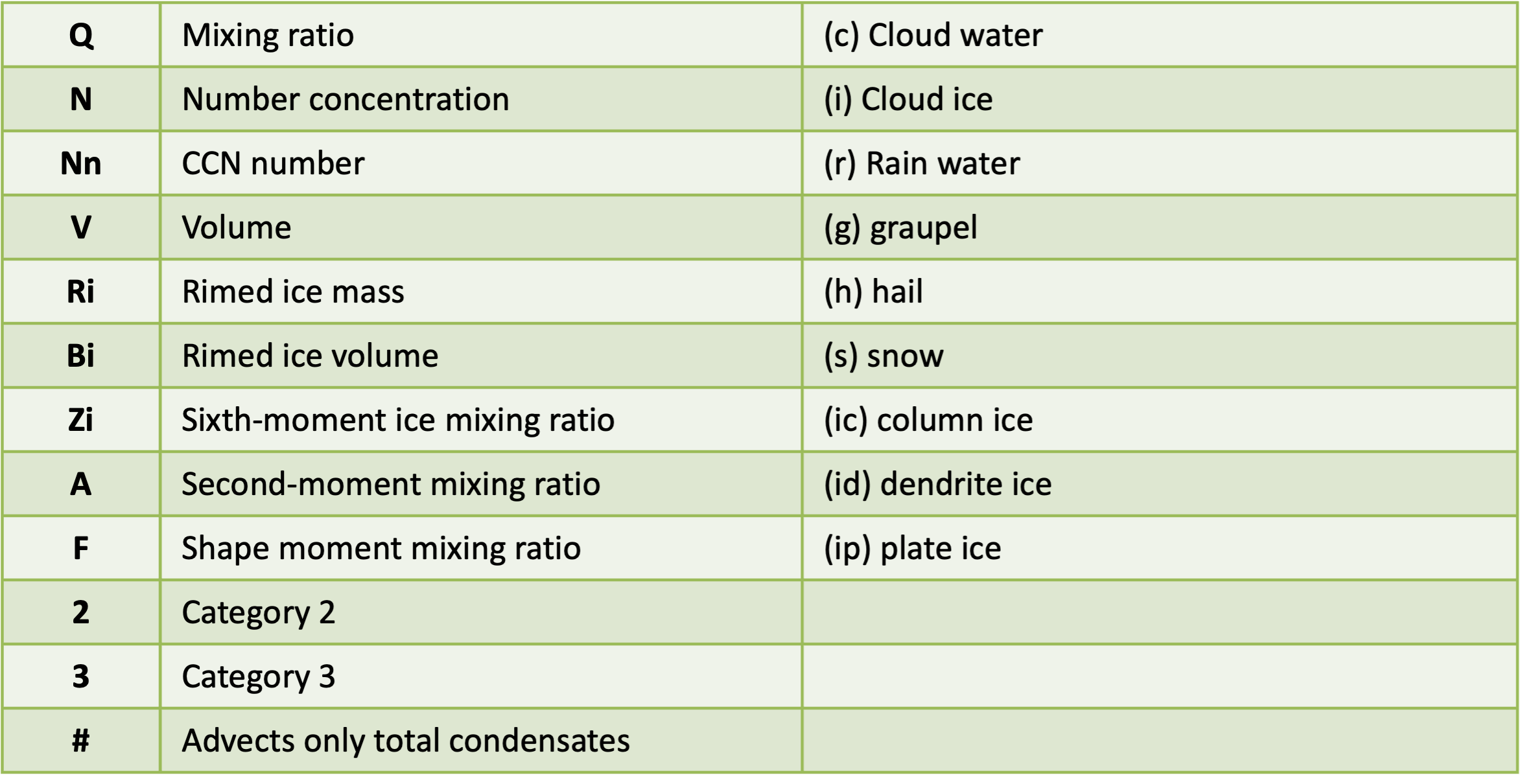
Scheme
Option
Mass Variables
Number Variables
Kessler
1
Qc Qr
N/A
Purdue Lin
2
Qc Qr Qi Qs Qg
N/A
WSM3
3
Qc Qr
N/A
WSM5
4
Qc Qr Qi Qs
N/A
Eta (Ferrier)
5
Qc Qr Qs Qt*
N/A
WSM6
6
Qc Qr Qi Qs Qg
N/A
Goddard 4-ice
7
Qc Qr Qi Qs Qg Qh
N/A
Thompson
8
Qc Qr Qi Qs Qg
Ni Nr
Milbrandt 2-mom
9
Qc Qr Qi Qs Qg Qh
Nc Nr Ni Ns Ng Nh
Morrison 2-mom
10
Qc Qr Qi Qs Qg
Nr Ni Ns Ng
CAM 5.1
11
Qc Qr Qi Qs
Nc Nr Ni Ns
SBU-YLin
13
Qc Qr Qi Qs
N/A
WDM5
14
Qc Qr Qi Qs
Nn Nc Nr
WDM6
16
Qc Qr Qi Qs Qg
Nn Nc Nr
NSSL 2-mom
17
Qc Qr Qi Qs Qg Qh
Nc Nr Ni Ns Ng Nh
NSSL 2-mom+CCN
18
Qc Qr Qi Qs Qg Qh
Nc Nr Ni Ns Ng Nh Nn
NSSL 7-class
19
Qc Qr Qi Qs Qg Qh
Vg
NSSL 6-class
21
Qc Qr Qi Qs Qg
N/A
NSSL 6-class 2-mom
22
Qc Qr Qi Qs Qg
Nn Nc Nr Ni Ns Ng Vg
WSM7
24
Qc Qr Qi Qs Qg Qh
N/A
WDM7
26
Qc Qr Qi Qs Qg Qh
Nc Nr
Thompson Aerosol
28
Qc Qr Qi Qs Qg
Nc Ni Nr Nn Nni
HUJI Fast
30
Qc Qr Qi Qs Qg
Nn Nc Nr Ni Ns Ng
HUJI Full
32
Qc Qr Qic Qip Qid Qs Qg Qh
Nn Nc Nr Nic Nip Nid Ns Ng Nh
P3
50
Qc Qr Qi
Nr Ni Ri Bi
P3-nc
51
Qc Qr Qi
Nc Nr Ni Ri Bi
P3-2nd
52
Qc Qr Qi2
Nc Nr Ni Ni2 Ri Ri2 Bi Bi2
P3-3mc
53
Qc Qr Qi
Nc Nr Ni Ri Bi Zi
ISHMAEL
55
Qc Qr Qi Qi2 Qi3
Nr Ni Ni2 Ni3 Vi Vi2 Vi3 Ai Ai2 Ai3
ISHMAEL
55
Qc Qr Qi Qi2 Qi3
Nr Ni Ni2 Ni3 Vi Vi2 Vi3 Ai Ai2 Ai3
Microphysics Option Details and References
Kessler
mp_physics=1
A warm-rain (i.e., no ice) scheme used commonly in idealized cloud modeling studies
Kessler, 1969Purdue Lin
mp_physics=2
A sophisticated scheme that has ice, snow, and graupel processes, suitable for real-data high-resolution simulations
Chen and Sun, 2002WRF Single-moment 3-class (WSM3)
mp_physics=3
A simple, efficient scheme with ice and snow processes, suitable for mesoscale grid sizes
Hong et al., 2004WRF Single-moment 5-class (WSM5)
mp_physics=4
A slightly more sophisticated version of WSM3 that allows for mixed-phase processes and super-cooled water
Hong et al., 2004Ferrier Eta
mp_physics=5
The operational microphysics used in NCEP models; simple and efficient, with diagnostic mixed-phase processes; for use with fine resolutions (<5km)
NOAA, 2001WRF Single-moment 6-class (WSM6)
mp_physics=6
Includes ice, snow and graupel processes, suitable for high-resolution simulations
Hong and Lim, 2006Goddard 4-ice
mp_physics=7
Predicts hail and graupel separately; provides effective radii for radiation. Replaced older Goddard scheme in V4.1.
Tao et al., 1989
Tao et al., 2016Thompson et al.
mp_physics=8
Includes ice, snow and graupel processes suitable for high-resolution simulations
Thompson et al., 2008Milbrandt-Yau Double-moment 7-class
mp_physics=9
Includes separate categories for hail and graupel with double-moment cloud, rain, ice, snow, graupel and hail
Milbrandt and Yau, 2005 (Part I)
Milbrandt and Yau, 2005 (Part II)Morrison Double-moment
mp_physics=10
Double-moment ice, snow, rain and graupel for cloud-resolving simulations
Morrison et al., 2009CAM V5.1 2-moment 5-class
mp_physics=11
User’s Guide to the CAM-5.1Stony Brook University (Y. Lin)
mp_physics=13
A 5-class scheme with riming intensity predicted to account for mixed-phase processes
Lin and Colle, 2011WRF Double-moment 5-class (WDM5)
mp_physics=14
Similar to WSM5 (option 4), but includes double-moment rain, and cloud and CCN for warm processes
Lim and Hong, 2010WRF Double-moment 6-class (WDM6)
mp_physics=16
Similar to WSM6 (option 6), but includes double-moment rain, and cloud and CCN for warm processes
Lim and Hong, 2010Note
For NSSL single-moment schemes (options 19 and 21), intercept and particle densities can be set for snow, graupel, hail, and rain. For the single- and double-moment schemes (options 17,18, 19, 21, and 22), shape parameters for graupel and hail can be set (in te &physics section of namelist.input).
nssl_alphah=0. : shape parameter for graupel
nssl_alphahl=2. : shape parameter for hail
nssl_cnoh=.e5 : graupel intercept
nssl_cnohl=4.e4 : hail intercept
nssl_cnor=8.e5 : rain intercept
nssl_cnos=3.e6 : snow intercept
nssl_rho_qh=500. : graupel density
nssl_rho_qhl=900. : hail density
nssl_rho_qs=100. : snow density
NSSL Double-moment
mp_physics=17
Two-moment scheme for cloud droplets, rain drops, ice crystals, snow, graupel, and hail; also predicts average graupel particle density, which allows graupel to span the range from frozen drops to low-density graupel
Mansell et al., 2010NSSL Double-moment with CCN prediction
mp_physics=18
Similar to option 17 (above), but also predicts cloud condensation nuclei (CCN) concentration (intended for idealized simulations); intended for cloud-resolving simulations (dx <= 2km) in research applications
Mansell et al., 2010
To set global CCN value, use “nssl_cccn=0.7e9,” which also sets the same value for “ccn_conc”
NSSL Single-moment 7-class
mp_physics=19
A single-moment version of option 17 (above)
No publication availableNSSL single-moment 6-class
mp_physics=21
Intended for cloud-resolving simulations (dx <= 2km) in research applications; similar to
Gilmore et al. (2004)NSSL Double-moment with Graupel
mp_physics=22
Similar to option 17 (above), without hail
No publication availableWRF Single-moment 7-class (WSM7)
mp_physics=24
Similar to WSM6 (option 6), but with an added hail category (effective beginning with V4.1)
Bae et al., 2018WRF Double-moment 7-class (WDM7)
mp_physics=26
Similar to WDM6 (option 16), but with an added hail category (effective beginning with V4.1)
Bae et al., 2018Thompson Aerosol-aware
mp_physics=28
Considers water- and ice-friendly aerosols
Thompson and Eidhammer, 2014
A climatology dataset may be used to specify initial and boundary conditions for the aerosol variables; includes a surface dust scheme.
Since V4.4 a black carbon aerosol category is added; biomass burning can also be added.
Hebrew University of Jerusalem Fast (HUJI)
mp_physics=30
Spectral bin microphysics, fast version
Khain et al., 2010Hebrew University of Jerusalem Full (HUJI)
mp_physics=32
Spectral bin microphysics, full version
Khain et al., 2004Morrison double-moment scheme with CESM aerosol
mp_physics=40
Similar to option 10, but with CESM aerosol added. This option must be used with the MSKF cumulus scheme (option 11)
No publication available for this specific schemeMorrison and Milbrandt Predicted Particle Property (P3)
mp_physics=50
A single ice category that represents a combination of ice, snow and graupel, and also carries prognostic arrays for rimed ice mass and rimed ice volume; single-moment rain and ice.
Morrison and Milbrandt, 2015Morrison and Milbrandt Predicted Particle Property (P3-nc)
mp_physics=51
As in 50, but adds supersaturation dependent activation and double-moment cloud water
Morrison and Milbrandt, 2015Morrison and Milbrandt Predicted Particle Property (P3-2ice)
mp_physics=52
As in option 50, but with two arrays for ice and double-moment cloud water
Morrison and Milbrandt, 2015Morrison and Milbrandt Predicted Particle Property (P3-3moment)
mp_physics=53
As in option 50, but with 3-moment ice, plus double-moment cloud water
No publication available for this specific schemeJensen ISHMAEL
mp_physics=55
Predicts particle shapes and habits in ice crystal growth; (new in V4.1)
Jensen et al., 2017National Taiwan University (NTU)
mp_physics=56
double-moments for the liquid phase, and triple-moments for the ice phase, together with consideration for ice crystal shape and density variations; supersaturation is resolved so that condensation nuclei (CN) activation is explicitly calculated; CN’s mass in droplets is tracked to account for aerosol recycling.
Tsai and Chen, 2020Next section: Radiation