
Radiation
Physics Contents
WRF Physics Overview
Cumulus Parameterization
Microphysics
Radiation
Planetary Boundary Layer (PBL) Physics
Surface Physics
Using Physics Suites
Physics Options for Specific Applications
Radiation Overview
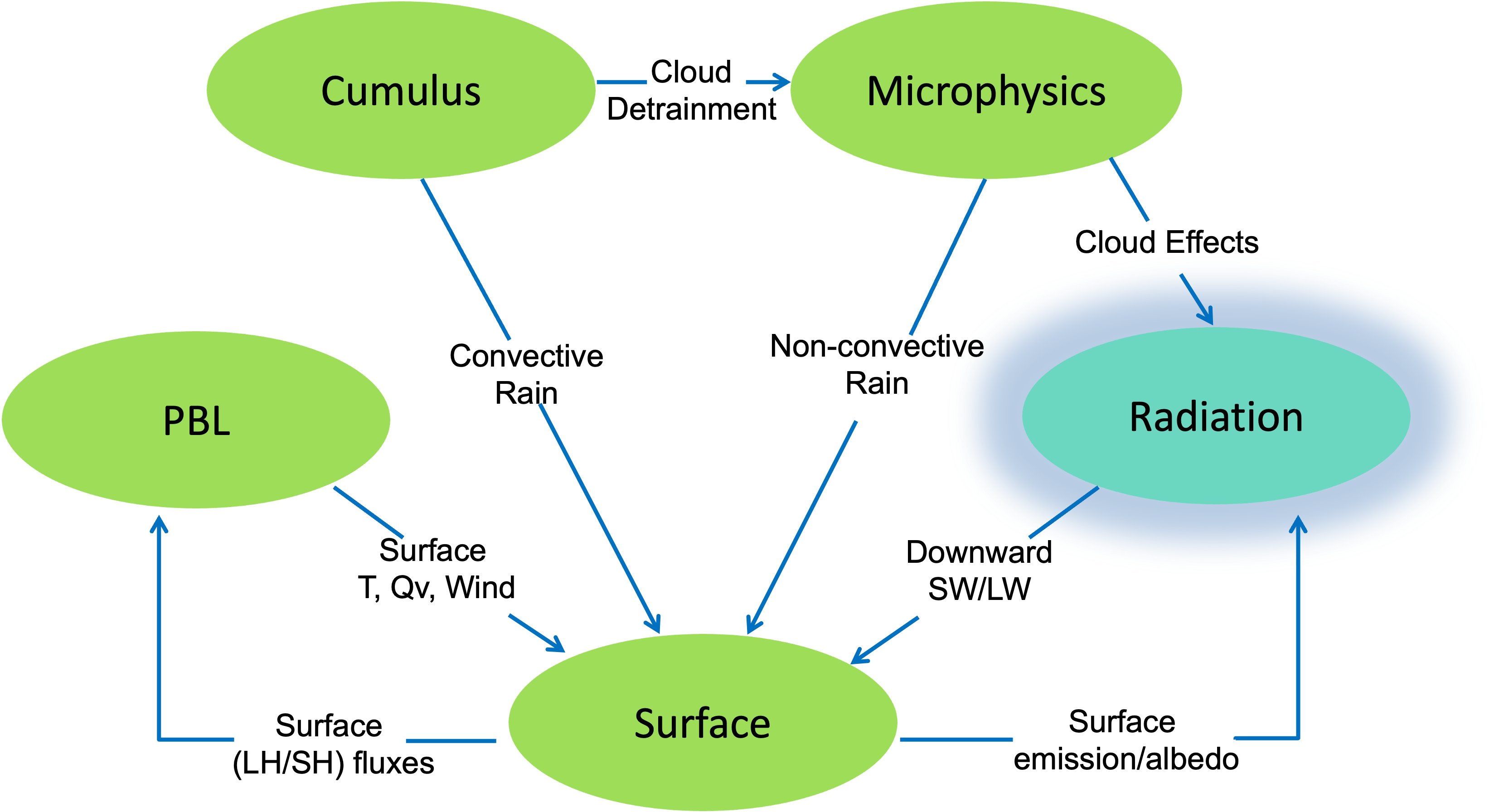

WRF radiation schemes obtain cloud effects from the microphysics scheme, and then compute an atmospheric temperature tendency profile, as well as surface radiative fluxes, due to longwave and shortwave radiation.
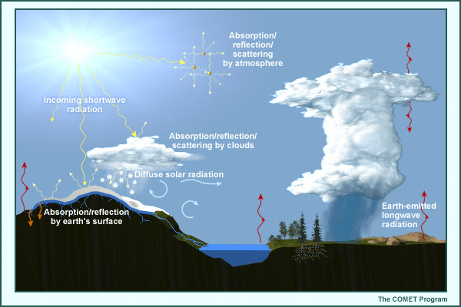
Longwave schemes are responsible for computing the outgoing longwave heat leaving the surface in clear-sky conditions, or it can be reflected back to the surface if it comes in contact with clouds or other atmospheric interruptions (e.g., pollutants). These include both infrared and thermal radiation.
Shortwave schemes compute incoming solar fluxes that either make it to the surface, or get deflected back into the atmosphere by cloud impediment or other barriers (e.g., pullutants). Shortwave schemes take into consideration annual cycles, as well as the diurnal cycle, since there is no incoming radiation at night time. These schemes include the visible wavelengths in the solar spectrum.
Note
See the `WRF Tutorial presentation on Radiation`_ for additional details.
Quicklinks to Radiation Sections
Click the following links to go directly to each radiation topic.
Longwave Radiation Scheme Details and References
Shortwave Radiation Scheme Details and References
Clouds and Cloud Fraction Options
Longwave Radiation Schemes
WRF longwave radiation schemes compute clear-sky and cloud upward and downward raditation fluxes.
They consider infrared emissions from layers.
Surface emissivity is calculated, based on the land type in each grid point.
Flux divergence of the layer emissions leads to cooling in each layer.
Downward flux at the surface is important in the land-energy budget.
Infrared radiation generally leads to cooling in clear air (~2K/day), with stronger cooling at cloud tops and warming at cloud bases.
In the table below, microphysics interactions are mixing ratios of (c) cloud water, (r) rain water, (i) cloud ice, (s) snow, and (g) graupel.
Scheme
Option
Microphysics Interaction
Cloud Fraction
GHG
RRTM
1
Qc Qr Qi Qs Qg
1/0
constant or yearly GHG
CAM
3
Qc Qi Qs
Max-rand overlap
yearly CO2 or GHG
RRTMG
4
Qc Qr Qi Qs
Max-rand overlap
constant or yearly GHG
New Goddard
5
Qc Qr Qi Qs Qg
Max-rand
constant
FLG
7
Qc Qr Qi Qs Qg
1/0
constant
RRTMG-K
14
Qc Qr Qi Qs
Max-rand overlap
constant
Held-Suarez
31
none
none
none
GFDL
99
Qc Qr Qi Qs
Max-rand overlap
constant
Back to Quicklinks to Radiation Sections
Longwave Radiation Scheme Details and References
RRTM
ra_lw_physics=1
Rapid Radiative Transfer Model. An accurate scheme using look-up tables for efficiency. Accounts for multiple bands, and microphysics species. For trace gases, the volume-mixing ratio values for CO2=379e-6, N2O=319e-9 and CH4=1774e-9. See section 2.3 for time-varying option.
Mlawer et al., 1997CAM
ra_lw_physics=3
from the CAM 3 climate model used in CCSM. Allows for aerosols and trace gases. It uses yearly CO2, and constant N2O (311e-9) and CH4 (1714e-9). See section 2.3 for the time-varying option.
Collins et al., 2004RRTMG
ra_lw_physics=4
A newer version of RRTM. It includes the MCICA method of random cloud overlap. For major trace gases, CO2=379e-6 (valid for 2005), N2O=319e-9, CH4=1774e-9. See section 2.3 for the time-varying option. Since V4.2, the CO2 value is replaced by a function of the year: CO2(ppm) = 280 + 90 exp (0.02*(year-2000)), which has about 4% of error for 1920s and 1960s, and about 1 % after year 2000 when compared to observed values. Since V4.4, a new cloud overlap option is available
Iacono et al., 2008New Goddard
ra_lw_physics=5
Efficient, multiple bands, ozone from simple climatology. Designed to run with Goddard microphysics particle radius information. Updated in V4.1.
Chou and Suarez, 1999
Chou et al., 2001Fu-Liou-Gu (FLG)
ra_lw_physics=7
multiple bands, cloud and cloud fraction effects, ozone profile from climatology and tracer gases. CO2=345e-6.
Gu et al., 2011
Fu and Liou, 1992RRTMG-K
ra_lw_physics=14
A version of RRTMG scheme improved by Baek (2017), A revised radiation package of G-packed McICA and two-stream approximation: Performance evaluation in a global weather forecasting model, J. Adv. Model. Earth Syst., 9, doi:10.1002/2017MS000994). Note: To use this option, WRF must be built with the configuration setting -DBUILD_RRTMK = 1 (modify in configure.wrf)
Baek, 2017RRTMG-fast
ra_lw_physics=24
A fast version of the RRTMG scheme
Iacono et al., 2008GFDL
ra_lw_physics=99
Eta operational radiation scheme. An older multi-band scheme with carbon dioxide, ozone and microphysics effects
Fels and Schwarzkopf, 1981Back to Quicklinks to Radiation Sections
Shortwave Radiation Schemes
WRF shortwave radiation schemes
compute clear-sky and cloudy solar fluxes
include annual and diurnal solar cycles
consider downward and upward (reflected) fluxes (with the exception of the Dudhia (option 1) scheme, which only considers downward flux)
have a primarily warming effect in clear sky
are an important component of surface energy balance
In the table below, microphysics interactions are mixing ratios of (c) cloud water, (r) rain water, (i) cloud ice, (s) snow, and (g) graupel.
Scheme
Option
Microphysics Interaction
Cloud Fraction
GHG
Dudhia
1
Qc Qr Qi Qs Qg
1/0
none
Goddard
2
Qc Qi
1/0
5 profiles
CAM
3
Qc Qi Qs
Max-rand overlap
lat/month
RRTMG
4
Qc Qr Qi Qs
Max-rand overlap
1 profile or lat/month
New Goddard
5
Qc Qr Qi Qs Qg
Max-rand
5 profiles
FLG
7
Qc Qr Qi Qs Qg
1/0
5 profiles
RRTMG-K
14
Qc Qr Qi Qs
Max-rand overlap
1 profile or lat/month
GFDL
99
Qc Qr Qi Qs
Max-rand overlap
lat/month
Back to Quicklinks to Radiation Sections
Shortwave Radiation Scheme Details and References
Dudhia
ra_sw_physics=1
Simple downward integration allowing efficiency for clouds and clear-sky absorption and scattering
Dudhia, 1989Goddard
ra_sw_physics=2
Two-stream multi-band scheme with ozone from climatology and cloud effects
Chou and Suarez, 1994
Matsui et al., 2018CAM
ra_sw_physics=3
Originates from the CAM 3 climate model used in CCSM; allows for aerosols and trace gases
Collins et al., 2004RRTMG
ra_sw_physics=4
Uses the MCICA method of random cloud overlap; use for major trace gases, CO2=379e-6 (valid for 2005), N2O=319e-9, CH4=1774e-9. See section 2.3 for the time-varying option. Since V4.2, the CO2 value is replaced by a function of the year: CO2(ppm) = 280 + 90 exp (0.02*(year-2000)), which has about 4% error for the 1920s and 1960s, and about 1% after 2000, when compared to observed values. To include a cloud overlap option, add namelist option cldovrlp = 1,2,3,4,or 5, along with decorrelation length option, idcor = 0 or 1 for use with cldovrlp=4 or 5. See namelist section for descriptions of options.
Iacono et al., 2008New Goddard
ra_sw_physics=5
Efficient, multiple bands, ozone from simple climatology; designed to run with Goddard microphysics particle radius information; updated in V4.1.
Chou and Suarez, 1999
Chou et al., 2001Fu-Liou-Gu (FLG)
ra_sw_physics=7
Includes multiple bands, cloud and cloud fraction effects, ozone profile from climatology, can allow for aerosols
Gu et al., 2011
Fu and Liou, 1992RRTMG-K
ra_sw_physics=14
An improved version of the RRTMG scheme; note: To use this option, WRF must be built with the configuration setting -DBUILD_RRTMK = 1 (modify in configure.wrf)
Baek, 2017RRTMG-fast
ra_sw_physics=24
A fast version of RRTMG (option 4)
Iacono et al., 2008Held-Suarez
ra_sw_physics=31
A temperature relaxation scheme designed for idealized tests only
No publication availableGFDL
ra_sw_physics=99
Eta operational scheme; two-stream multi-band scheme with ozone from climatology and cloud effects
Fels and Schwarzkopf, 1981Namelist Options Related to Shortwave Radiation
slope_rad=1 : include slope and shading effects; modifies surface solar radiation flux according to terrain slope
topo_shading=1 : allows for shadowing of neighboring grid cells; use only with high-resolution runs with grid size less than a few kilometers
swrad_scat : scattering turning parameter for use with “ra_sw_physics=1;” default value is 1, which is equivalent to 1.e-5 m2/kg; when the value is greater than 1, scattering is increased
ra_sw_eclipse=1 : eclipse effect on shotwave radiation; only works with ra_sw_physics options 4 (RRTMG), 5 (New Goddard), 2 (Goddard), and 1 (Duhhia). The eclipse data from 1950 – 2050 is provided in WRF/run/eclipse_besselian_elements.dat.
swint_opt=1 : interpolation of short-wave radiation based on the updated solar zenith angle between shortwave calls
swint_opt=2 : activates the Fast All-sky Radiation Model for Solar applications (FARMS). FARMS is a fast radiative transfer model that allows simulations of broadband solar radiation every model time step. The model uses lookup tables of cloud transmittances and reflectances by varying cloud optical thicknesses, cloud particle sizes, and solar zenith angles. A more detailed description is provided in Xie et al., 2016
Back to Quicklinks to Radiation Sections
Input to Radiation Options
CAM Green House Gases
Provides yearly green house gases from 1765 to 2500. Beginning with V4.4, this is a runtime option (controlled by ghg_input=1 in the &physics section of the namelist; previously had to be activated by compiling WRF with the macro –DCLWRFGHG added in configure.wrf). Once compiled, CAM (3), RRTM (1), and RRTMG (4) long-wave schemes will see these gases. Ten scenario files are available in the test/em_real and run/ directories:
from IPCC AR5: CAMtr_volume_mixing_ratio.RCP4.5/RCP6/RCP8.5
from IPCC AR4: CAMtr_volume_mixing_ratio.A1B/A2
from IPCC AR6: CAMtr_volume_mixing_ratio.SSP119/SSP126/SSP245/SSP370/SSP585
the default points to the CAMtr_volume_mixing_ratio.SSP245 file
Climatological ozone and aerosol data for RRTMG
The ozone data are adapted from CAM radiation (ra_*_physics=3), and have latitudinal (2.82 degrees), height, and temporal (monthly) variation, as opposed to the default ozone used in the scheme, which only varies with height. This is activated by namelist option “o3input=2,” which is the default option. The aerosol data are based on Tegen et al., 1997, which has 6 types: organic carbon, black carbon, sulfate, sea salt, dust, and stratospheric aerosol (volcanic ash, which is zero). The data also have spatial (5 degrees in longitude and 4 degrees in latitudes) and temporal (monthly) variations. The option is activated by the namelist option “aer_opt=1.”Aerosol input for RRTMG and Goddard radiation options (aer_opt=2)
Either AOD or AOD plus Angstrom exponent, single scattering albedo, and cloud asymmetry parameter can be provided via constant values from the namelist or 2D input fields via auxiliary input stream 15. Aerosol type can also be set.Aerosol input for RRTMG radiation scheme (aer_opt=3)
From climatological water- and ice-friendly aerosols. This option only works with Thompson aerosol-aware microphysics (option 28).Effective cloud water, ice and snow radii for RRTMG radiation scheme (use_mp_re=1)
These come from Thompson (8), WSM (3,4,6,24), WDM (14,16,26), Goddard 4-ice (7), NSSL (17,18,19,21,22), and P3 (50-53) microphysics schemes.Back to Quicklinks to Radiation Sections
Clouds and Cloud Fraction Options
Longwave Radation and Clouds
All radiation schemes interact with resolved model cloud fields, allowing for ice and water clouds and precipitating species. Some nuances include
Some microphysics options pass their own particle sizes to RRTMG radiation (cloud droplets, ice and snow)
Other combinations only use mass information from microphysics, and assume effective sizes in the radiation scheme
Rain and graupel effects are smaller than cloud and snow, and are not often explicitly considered
Clouds strongly affect IR at all wavelengths (considered “grey bodies”) and are almost opaque to it.
Shortwave Radiation and Clouds
Considerations for shortwave radiation schemes are similar to those of longwave schemes. There are interactions with model resolved clouds, and, in some cases, cumulus schemes. There are also fraction and overlap assumptions, as well as cloud albedo reflection. Surface albedo reflection is based on the land-surface type and snow cover.Cloud Fraction for Microphysics Clouds
icloud=1 : Xu and Randall method; fraction is only <1 for small cloud amounts, 0 for no resolved cloud
icloud=2 : Simple 0 or 1 method with small resolved cloud threshold
icloud=3 : Thompson option (RH dependent); 1 > Fraction > 0 for high RH and no resolved clouds
Cloud Fraction for Unresolved Convective Clouds
cu_rad_feedback=.true. : only works for Grell Freitas (3), Grell 3 (5), Grell-Devenyi (93), and Kain Fritsch (1) radiation options.
ZM separately provides cloud fraction to radiation
Back to Quicklinks to Radiation Sections
Radiation Time Step (radt)
The namelist parameter “radt” controls the radiation time step. Consider the following when setting radt.
Radiation is too expensive to call every step.
Frequency should resolve cloud-cover changes with time.
radt=1 minute per km grid size (of domain 1) is about right (e.g., radt=10 for dx=10 km).
Each domain can have its own value but it is recommended to use the same value on all 2-way nests.
Next section: Planetary Boundary Layer (PBL) Physics