MPAS Data Assimilation
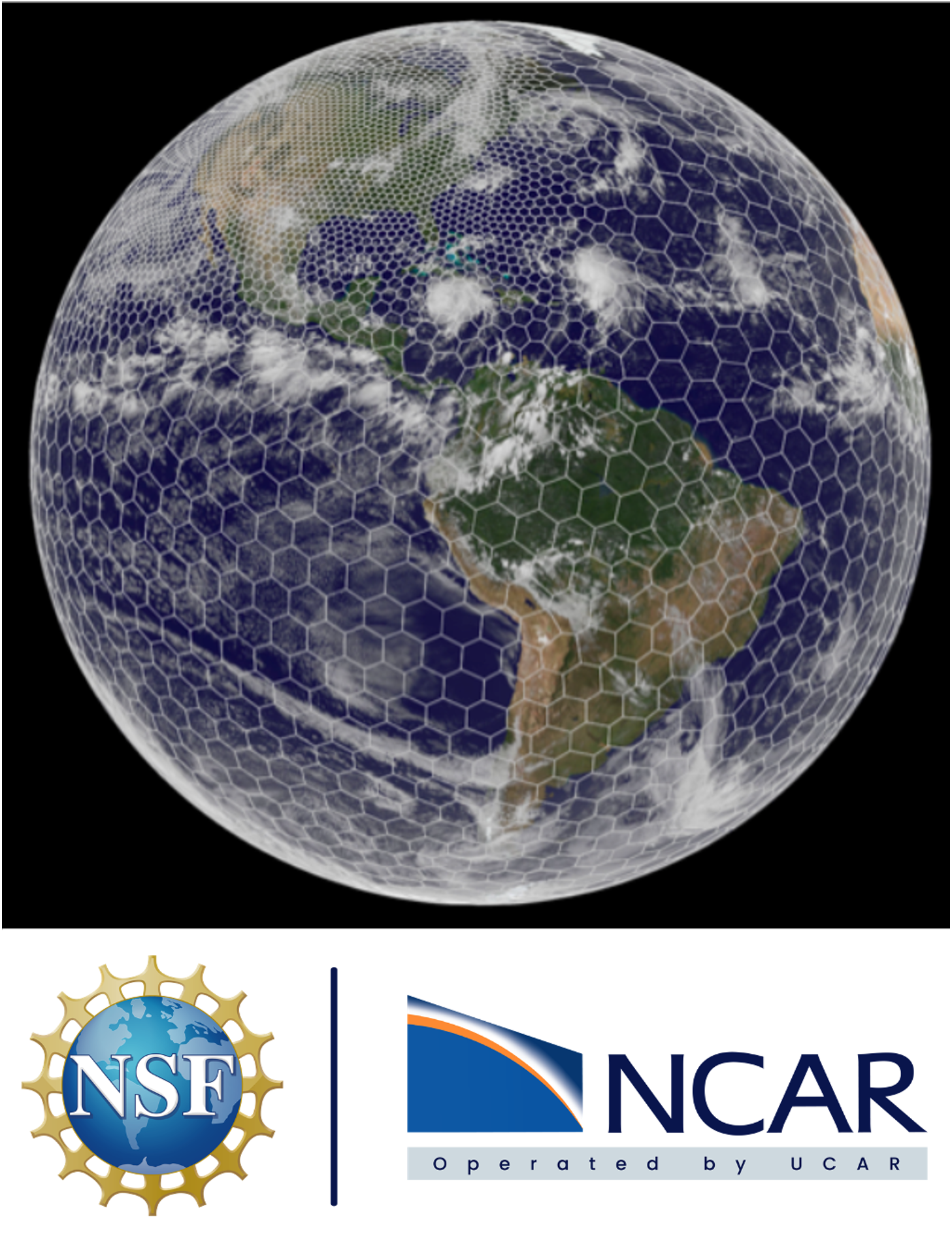
MPAS-JEDI offers a versatile data-assimilation system for MPAS and is the focus of development within NSF NCAR/MMM. MPAS-JEDI provides interfaces for MPAS to the Joint Effort for Data assimilation Integration (JEDI), whose development is led by the Joint Center for Satellite Data Assimilation (JCSDA). MPAS-JEDI benefits from collaboration with the JCSDA core team and leverages contributions to JEDI from other partners, including NOAA, NASA, UK Met Office, and US Navy. MPAS-JEDI’s capabilities include the use of regional, global, quasi-uniform, and variable-resolution MPAS meshes, the direct assimilation of remotely sensed observations, such as satellite radiances, and both variational and ensemble DA techniques.
Resources
MPAS-JEDI Tutorial Practice Guide based on latest tagged code
An implementation of a serial ensemble Kalman filter for MPAS, through the Data Assimilation Research Testbed (DART), is also available. MPAS/DART was developed in collaboration with the Data Assimilation Research Section within NSF NCAR’s Computational and Information Systems Lab. For further information, see Ha et al. 2017 or the DART pages.
Publications
MPAS-JEDI papers authored by NCAR staff:
Implementation and initial global 3DEnVar results, Liu et al. 2022
Ensemble of data assimilations (EDA), Guerrette et al. 2023
Static background-error covariances and 3DVar results, Jung et al. 2024
Results with global hybrid 4DEnVar, Nystrom et al 2025
Convection-allowing DA on a global variable-resolution mesh, Schwartz et al 2025
Local Ensemble Transform Kalman filter (LETKF) and all-sky AMSU-A DA, Sun et al 2025
Radar assimilation in a regional domain, Kong et al. 2026
All-sky assimilation of ATMS in MPAS-JEDI, Ban et al. 2026 (submitted)
Assimilation of airborne GNSS-RO in MPAS-JEDI, Baños et al. 2026 (submitted)
Radar reflectivity assimilation in a regional domain in the tropics, Sun et al. 2026 (submitted)